


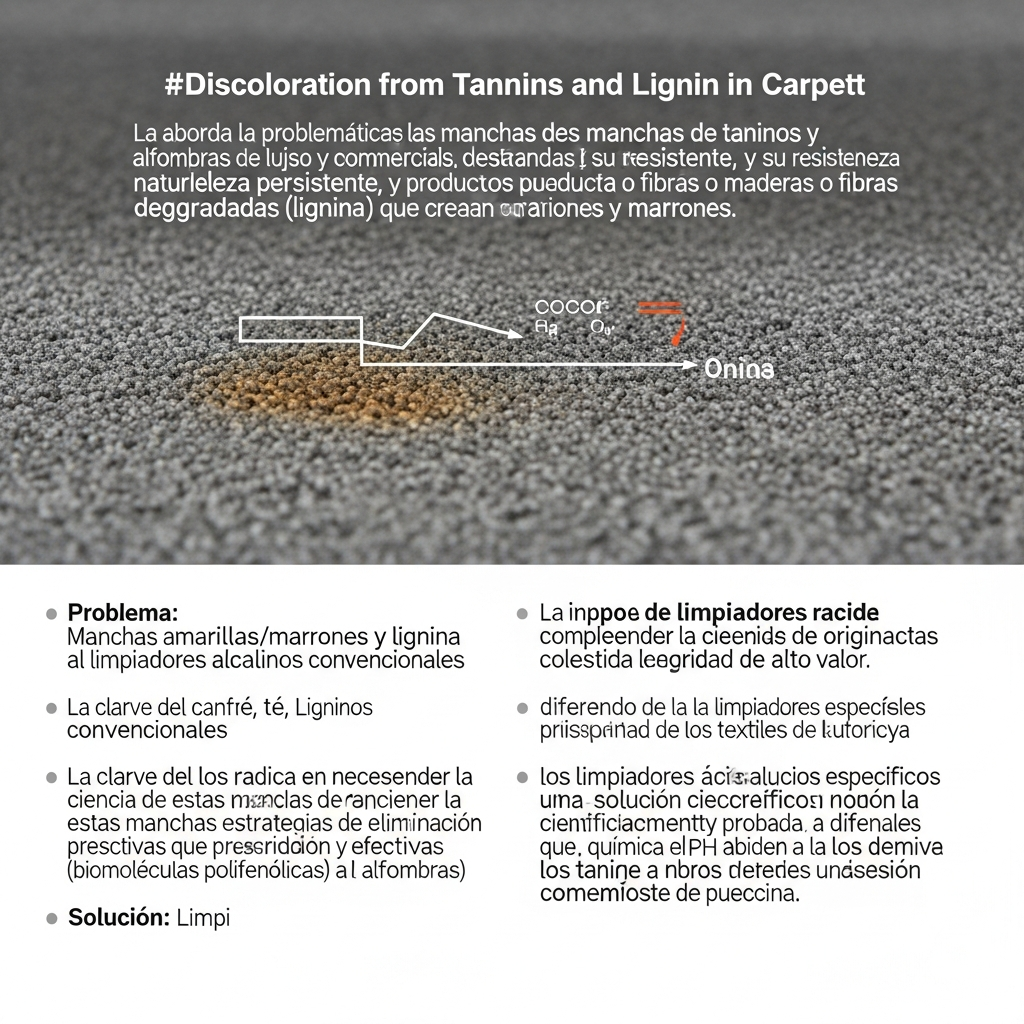
In the realm of luxury and commercial carpet maintenance, few challenges are as persistent or chemically complex as discoloration from tannins and lignin. These naturally occurring organic compounds—tannins from sources like coffee, tea, and wine, and lignin from wood-based products and natural fiber degradation—create stubborn yellow and brown stains that defy conventional alkaline cleaners. Understanding the molecular science behind these stains is not merely academic; it is critical for executing a precise, effective removal strategy that preserves the integrity of high-value textiles. While typical cleaners often fail, targeted acidic spotters offer a scientifically proven solution.
The core issue lies in pH chemistry. Tannins, which are polyphenolic biomolecules, bond aggressively with carpet fibers, particularly when introduced via hot liquids which open up the fiber’s molecular structure for deeper penetration. These stains are acidic in nature, meaning an alkaline cleaning agent (with a pH above 7) will often chemically set the stain, making it darker and virtually permanent. Scientific analysis reveals that effective tannin removal requires an acidic spotter, typically within a pH range of 3 to 4. This acidic environment neutralizes the alkaline characteristics of the tannin, breaking the chemical bonds holding it to the fiber and allowing it to be rinsed away. Professional-grade acidic spotters achieve a removal rate over 90% on fresh tannin stains when applied correctly, compared to less than 40% for high-pH alternatives.
Lignin discoloration, often seen as cellulosic browning in natural fibers like jute or cotton, presents a similar but distinct chemical puzzle. Lignin is a complex polymer that provides rigidity to plant cell walls. When natural fibers are exposed to high-alkaline cleaning solutions (pH 10 or higher) or excessive moisture with slow drying times, the lignin is solubilized and wicks to the fiber surface, appearing as a diffuse brown stain as it dries. Research indicates that lignin’s color is highly pH-sensitive; it lightens in a low-pH environment. Acidic treatments can make the discoloration seem to disappear by lowering the pH below 3, but to fully remove the lignin, it must be rendered water-soluble at a pH above 7.8 and then thoroughly flushed. More advanced treatments use reducing agents or controlled oxidation to chemically break down the color-causing components of the lignin molecule itself for permanent correction.
Ultimately, successfully treating tannin and lignin stains requires moving beyond one-size-fits-all solutions and embracing a prescriptive, chemistry-led approach. The protocol is clear: diagnose the stain source, select an appropriately formulated acidic spotter or reducer, and control application to neutralize the stain without damaging the carpet fiber or its dye sites. For tannins, a low-pH acidic spotter is the primary tool. For lignin browning, a combination of pH manipulation and, if necessary, a specialized reducing agent offers the most effective, scientifically-backed path to restoration. This targeted intervention ensures that valuable carpets are not just cleaned, but chemically restored to their original state.
No responses yet