


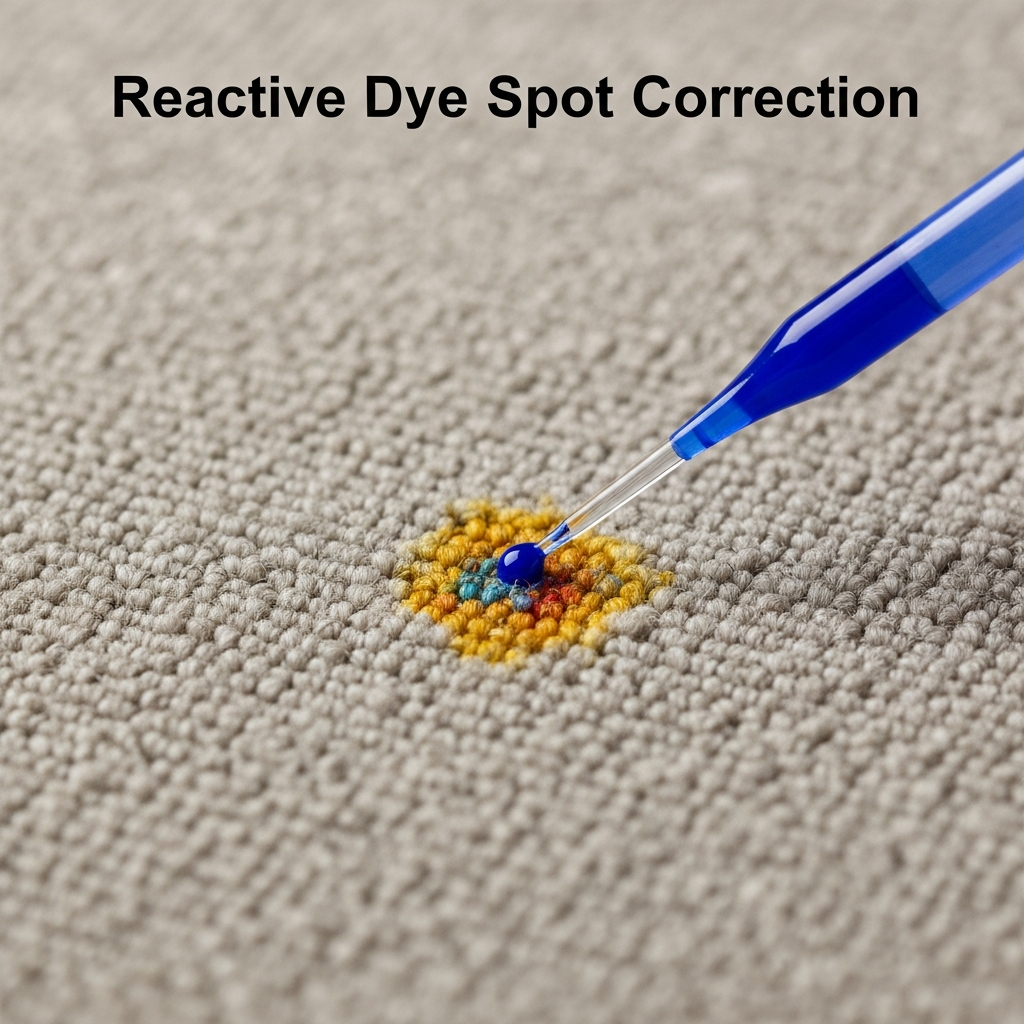
In the realm of luxury and commercial carpeting, color damage from bleach, chemical spills, or UV exposure represents a critical asset liability. Traditional cleaning addresses stains, which are additive substances, but color loss is a subtractive issue requiring a molecular solution. Reactive dye spot correction is not merely a cosmetic fix; it is a precise chemical procedure that re-establishes permanent color at the fiber level. This advanced technique hinges on a scientific understanding of fiber chemistry, ensuring the repair is indistinguishable from and as durable as the original carpet dye.
The efficacy of a reactive dye repair is rooted in the principle of dye-site saturation within nylon and wool fibers. These fibers possess a finite number of positively charged molecular locations, or “dye sites,” where the original anionic dyes are anchored. When color loss occurs, these sites are left empty and available. A reactive dye correction introduces new dye molecules that don’t just coat the fiber; they form a covalent dye bond—the strongest type of chemical bond, where atoms share electrons. This reaction permanently integrates the new color into the fiber’s molecular structure, a bond far superior to the weaker ionic or hydrogen bonds found in many conventional dyes. This ensures the repair resists future cleanings and wear with exceptional durability, essentially becoming part of the carpet itself.
Beyond visual perfection, the true measure of a professional dye repair is its quantifiable longevity. The industry benchmarks this using rigorous colorfastness testing, specifically the ISO 105-B02 standard, which evaluates a textile’s resistance to artificial light. This test uses a xenon arc lamp to simulate intense, prolonged sun exposure. A competently executed reactive dye repair is expected to achieve a colorfast-light rating of Grade 4 or higher on the standardized 5-point Gray Scale. This metric signifies that the repaired area will exhibit minimal to no fading, even under conditions that would degrade inferior treatments. Achieving this rating proves the covalent-dye-bond is stable and the repair will maintain its integrity for the service life of the carpet.
Ultimately, successful reactive dye spot correction is a testament to applied science. It moves beyond simple color matching to a sophisticated process of molecular engineering. By leveraging the chemistry of dye-site saturation to forge a permanent covalent-dye-bond, technicians can offer a repair that is not only visually seamless but is scientifically verified to last. For facility managers and owners of fine carpeting, understanding this process is key. We recommend inquiring about the specific types of dyes used and their projected colorfast-light ratings to ensure any color restoration investment is a durable, long-term solution that protects the asset’s value.
No responses yet