


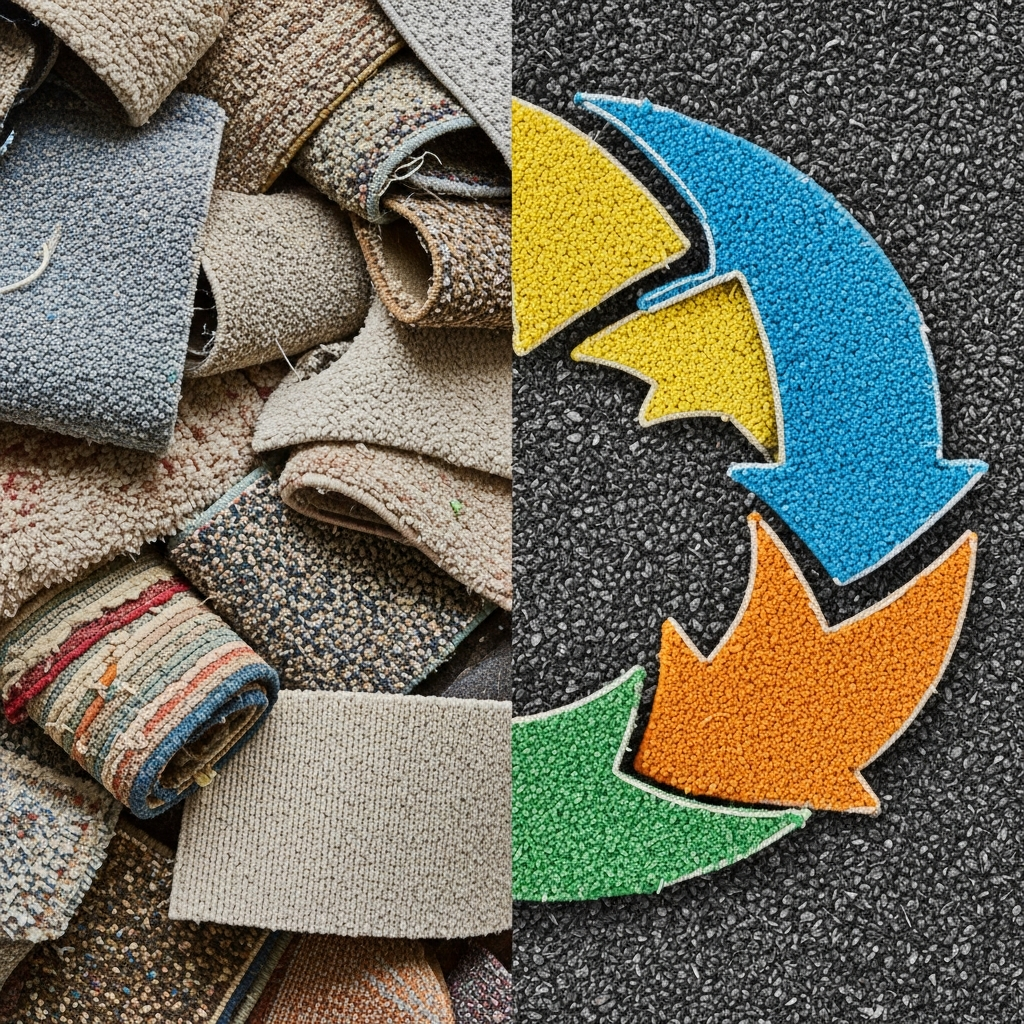
The traditional linear model of ‘take-make-dispose’ is a significant liability in the textile industry, with carpets representing a substantial portion of landfill waste. In the United States alone, billions of pounds of carpet are discarded annually, creating a pressing need for sustainable, circular solutions. This shift is not merely an environmental imperative but a sophisticated business strategy, transforming end-of-life products into valuable raw materials. The modern flooring industry is now at the forefront of this evolution, leveraging advanced science and technology to turn discarded textiles into high-performance assets, effectively closing the loop and redefining the lifecycle of a carpet.
A primary breakthrough in carpet circularity lies in the chemical recycling of Nylon 6 fibers. Unlike mechanical recycling, which often results in downcycling, a process called depolymerization allows Nylon 6 to be chemically broken down to its original monomer, caprolactam. This process yields a raw material indistinguishable from its virgin counterpart, enabling the creation of new carpet fibers with no loss of quality. This creates a true cradle-to-cradle loop, drastically reducing reliance on petroleum feedstocks and lowering the global warming impact of nylon production by up to 90%. This scientific achievement is the cornerstone of a genuinely circular carpet economy, allowing a polymer to be infinitely renewed without degradation.
However, the success of circularity hinges on precise material identification and sorting. With modern carpets composed of complex blends, distinguishing between polymers like Nylon 6, PET (polyester), and polypropylene at scale is a major challenge. This is where technology becomes critical. Advanced handheld devices using near-infrared (NIR) spectroscopy, such as the industry-supported CarpeTell scanner, can now identify carpet fiber types in less than half a second. This rapid, accurate sorting is essential to channel materials into the correct recycling streams—ensuring high-purity Nylon 6 reaches depolymerization plants while other materials are directed to appropriate recycling or energy recovery processes. Initiatives like the California Carpet Stewardship Program, which achieved a record 35.1% recycling rate in 2023, demonstrate how technology and policy can drive monumental change, diverting over 66 million pounds of carpet from landfills in a single year.
The transition to a circular economy for carpets is a complex but achievable goal, moving beyond theory into tangible practice. It requires a systemic approach that combines designing products for disassembly, investing in sophisticated chemical recycling infrastructure, and deploying advanced sorting technologies. For corporations and luxury property managers, specifying flooring from manufacturers committed to take-back programs and the use of infinitely recyclable materials like Nylon 6 is not just a sustainable choice—it’s an investment in a resilient supply chain and a testament to a forward-thinking brand identity. The future of flooring is not disposable; it is renewable.
No responses yet